
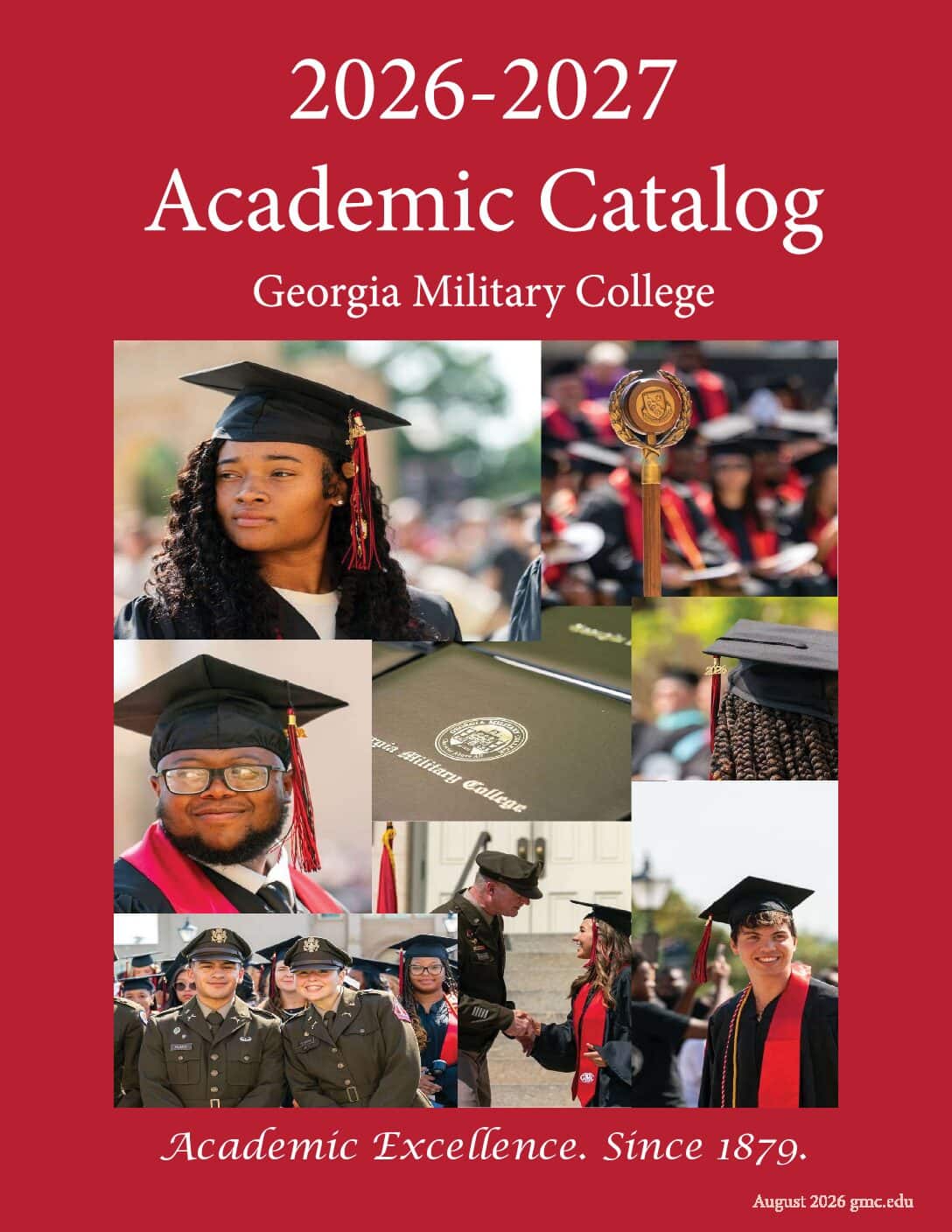
Academic Catalog
This catalog is your guide to Georgia Military College.
The statements outlined in this catalog are for informational purposes only and should not be construed as the basis of a contract between a student and this institution. While every effort will be made to ensure the accuracy of the material stated herein, Georgia Military College reserves the right to change any provision listed in this catalog, including but not limited to academic requirements for graduation, curricula, course offerings, and academic regulations without actual notice to individual students. Every effort will be made to keep students advised of such changes. All students should contact their graduation coach to confirm the correct catalog based on their enrollment.
Academic Catalog: Frequently Asked Questions
These answers summarize common policies and procedures from the 2026–2027 GMC Academic Catalog. The catalog is the official source; if anything here appears to differ from it, the catalog governs. Your Graduation Coach is your best first stop for questions about your own situation.
Why is GMC asking me for a non-attendance letter from another college?
What it is: A non-attendance letter is an official letter from another college’s Registrar or Admissions Office confirming that you did not attend that school, either during a specific term or at all.
When it’s required: As part of the admissions process, GMC checks national enrollment records, such as the National Student Clearinghouse. If those records show enrollment at a college you did not list or say you never attended, GMC needs either an official transcript or a non-attendance letter from that college before your file can be completed. This often happens when a student:
- applied, was accepted, or registered for classes but never attended;
- dropped all classes before the term began; or
- took dual-enrollment courses in high school and did not realize they count as college attendance.
Why GMC requires it: GMC requires official transcripts from all colleges and universities you have previously attended. Your prior college record affects:
- your admission decision and initial academic standing, because transfer students’ standing (good standing, warning, probation, or suspension) is based on their most recent college terms;
- transfer credit you may be able to apply toward your GMC degree; and
- financial aid eligibility, because transfer hours count toward Satisfactory Academic Progress and the maximum time allowed to finish a degree.
When national records and your application don’t match, GMC must resolve the difference before making a decision. The non-attendance letter is official proof from the other college that no academic record exists there. Providing false, incomplete, or misleading information about your academic history may result in denial of your application or dismissal from GMC.
How to get one: Contact the Registrar’s or Admissions Office at the college in question and request a letter of non-attendance. Ask them to send it directly to the GMC Admissions Office. If that college’s records show you did attend, even briefly, ask them to send an official transcript instead. Your admission file will remain incomplete until GMC receives one or the other.
Who is responsible for making sure I meet my degree requirements?
You are. Every GMC student is assigned a Graduation Coach who helps plan course schedules, explains college policy, and monitors academic progress, but the catalog states that final responsibility for meeting all academic regulations and degree requirements rests with the student.
Students are also responsible for reading the Student Handbook, following published deadlines on the Academic Calendar, and reading the syllabus for each course.
How do I register, and how do I add or drop a class?
Registration is completed through your Graduation Coach after you review the Student Planner in the GMC Portal. Your initial advising appointment normally plans an academic year and registers you for two terms. Early registration is recommended for the best course selection.
Classes may be added or dropped only during the drop/add period shown on the Academic Calendar, and only in consultation with your Graduation Coach. No one may register after drop/add ends.
- Courses dropped during drop/add receive a 100% refund of tuition and fees.
- If you register and then decide not to attend, you must officially drop before drop/add ends. Simply not attending does not drop you, and you may be billed.
- Changing your course load can change your financial aid, so talk with your Graduation Coach first.
How do I change or add a major?
All degree-seeking students declare a major when they enter GMC, but you may change your major at any time. Submit a written request to your Graduation Coach. To move from an associate degree to a bachelor’s program, use the Associate’s-to-Bachelor’s Change of Major form. Other changes of major or location use the Change of Location/Major form.
- Which catalog applies: If your current catalog is within two years of the current catalog and your new major appears in both, you stay under your current catalog’s degree requirements. If your catalog is more than two years old, or the new major isn’t in it, you move to the current catalog and its requirements.
- How many programs: You may have no more than two active degree programs at a time. Once one degree is completed and closed out, you may add a third by written request. Certificates may be active at the same time as your degree programs.
- Plan ahead: Changing majors can add courses to your plan, and the maximum time allowed for financial aid is not extended. Review the change with your Graduation Coach before submitting it.
Can I take more than a full course load in one term?
A typical full load is 15 to 17 quarter hours. Enrolling in 20 or more quarter hours is an overload and requires approval from the senior academic administrator at your site. A request is usually approved when you have:
- an average grade of B in the previous quarter;
- enrollment in a pre-professional program that requires special credits; or
- an extra course required within your last three quarters before graduation.
Cadets who need to overload with a Military Science course may be approved for 20 or 21 quarter hours by the AVP of Junior College Academics on the Main Campus. To start a request, contact your Graduation Coach.
How do I withdraw from a course after the drop/add period?
Email your professor from your official GMC email account by the Last Day to Withdraw without Academic Penalty, as published on the Academic Calendar. A grade of “W” will be posted, which does not affect your GPA.
- Withdrawals are allowed beginning the day after drop/add ends. No withdrawals are allowed during the final 14 calendar days of a term.
- If you still appear on the course roster one week after your request, follow up with your Graduation Coach.
- No tuition or fees are refunded for withdrawals after drop/add, and a withdrawal may reduce your financial aid and leave a balance due.
- Cadets, student athletes, and international students typically must stay enrolled in at least 12 quarter hours.
Dual-enrollment students: Talk with your high school counselor before asking your instructor to withdraw you. Dual-enrollment funding will not pay for you to retake a course you withdrew from, and you become ineligible for further dual-enrollment funding after your second course withdrawal. High school students who are not eligible for dual-enrollment funding may take college courses at their own expense as joint-enrollment students.
Before withdrawing, check with both your Graduation Coach and your professor.
Does GMC have an attendance policy? What counts as an excused absence?
GMC does not have a compulsory attendance policy, but you must attend beyond the drop/add period to be eligible for certain types of financial aid. In online courses, logging in does not count as attendance; you must submit work. Online students also take a Participation and Academic Honesty Verification (PAHV) quiz at the start of the term.
Excused absences include:
- court-mandated appearances, such as jury duty or serving as a witness;
- military duty, such as deployments, a Permanent Change of Station, or TDY;
- approved GMC events, such as athletic events, Cadet activities, performances, and course trips;
- medical appointments; and
- for dual-enrollment students, mandatory events planned by your high school, when a high school official notifies the senior academic administrator in writing.
Notify your professor before the absence whenever possible and, within one day of returning, arrange to make up missed work. Make-up and late-work policies otherwise vary by course, so read each syllabus carefully. Cadet Pass and Leave forms are not excused absences.
What is an “Incomplete” grade, and how do I resolve one?
An Incomplete (“I”) may be given when you were doing satisfactory work and had completed a substantial majority of the course, but could not finish for reasons beyond your control. The decision is the instructor’s.
You must finish the remaining work no later than midterm of the next quarter, unless the senior academic administrator grants an exception. If the work is not completed, the “I” becomes an “F.”
Can I repeat a course to improve my grade?
Yes. You may repeat any college-level course in which you earned a “D,” “F,” or “W.” The highest grade is used in your cumulative GPA, but every attempt stays on your transcript.
- Financial aid will not pay for more than one repeat of a previously passed course.
- All grades are still used for financial aid calculations, and other colleges may use all grades for admission decisions.
- A higher grade does not remove a warning, probation, or suspension you received when the original grade was earned.
Learning Support Services (LSS) courses follow a separate repeat policy.
What should I do if I think a grade is unfair?
You have the right to appeal any grade you believe was unfairly assigned. The process moves in steps:
- Step 1: Complete your part of the Academic Grade Appeal Form and meet with the faculty member. For final grades, this must happen within 30 calendar days of the grade being posted.
- Step 2: If the matter is not resolved, submit a written request to the Department Chair or senior academic administrator within five business days from meeting with the faculty member. A written response is due within ten business days.
- Step 3: If the matter is still not resolved, submit a written appeal through the senior academic administrator, within five business days of receiving the reviewer’s response, to the Associate Vice President of Junior College Academics (or the Vice President of Online Academics for online courses).
The decision at Step 3 is final.
What is an academic petition?
Although some policies, such as academic standing, cannot be petitioned, every current or former GMC student has the right to submit a timely petition where applicable. Petitions are available from your Graduation Coach and are completed with their help. They are used to:
- address an undue hardship or a specific inequity that affects your ability to meet academic requirements;
- get approval for a special agreement between you and a faculty member on an academic matter, such as an independent study; and
- handle an emergency caused by unforeseen complications in completing academic requirements.
. Your Graduation Coach can tell you whether a petition applies to your situation.
What are academic warning, probation, and suspension?
These standings are based on your term GPA and cumulative GPA:
- Warning: applied automatically when your term GPA is below 1.50 or your cumulative GPA falls below the minimum for your hours attempted (1.50 for 0–18 hours, 1.70 for 19–37, 1.90 for 38–56, and 2.00 for 57 or more).
- Probation: follows a warning term if your term GPA is below 2.00 or your cumulative GPA is still below the minimum.
- How probation ends: Probation is removed when your term GPA during probation is at least 2.00 and raises your cumulative GPA to the required minimum. If you earn at least a 2.00 for the term but your cumulative GPA is still below the minimum, you remain on probation and may keep enrolling while you raise it.
- Suspension: applies if you do not earn the term or cumulative GPA needed to continue on probation. You may not attend the next term (summer may serve as the suspension term). A third suspension results in one calendar year away from GMC. Financial aid is terminated during suspension.
Academic standing cannot be petitioned. After a one-term suspension, you may apply for readmission.
What is Satisfactory Academic Progress (SAP), and how does it affect my financial aid?
To keep receiving financial aid, you must meet three SAP standards, which the Financial Aid Office reviews at the end of every term. Credits you transferred to GMC count toward all three.
- Minimum cumulative GPA: calculated on all grades, including repeated courses.
- Completion rate: you must complete at least 67% of all credits attempted at GMC plus credits transferred and accepted from other schools.
- Maximum time frame (the 150% rule): your attempted and transferred credits cannot exceed 150% of the hours required for your primary degree.
Grades of F, I, IP, IU, U, W, WF, and XF count as attempted but not earned.
Warning and suspension: Missing the GPA or completion-rate standard generally results in one Financial Aid Warning term, followed by SAP Suspension if it is not corrected. Exceeding the maximum time frame has no warning term; students are placed directly on SAP Suspension.
SAP is separate from academic standing, so a student can be in good academic standing and still have a financial aid problem. If a grade changes, you must ask the Financial Aid Office to review your SAP status.
Will my credits from another college or from military training transfer?
Credit from accredited colleges and universities is evaluated for transfer when you earned a “C” (2.0) or better. Transfer credit is awarded based on comparability with GMC’s courses and programs, as recommended by the appropriate Degree Program Coordinator or Program Dean. Courses from non-accredited institutions are not reviewed.
- Transfer limits: up to 67.5 quarter hours toward an associate degree (AA, AS, or AAS) and up to 135 quarter hours toward a Bachelor of Applied Science (BAS). Exemptions require a petition.
- Residency: at least 25% of the hours required for your degree must be completed at GMC.
- Military training: evaluated using American Council on Education (ACE) recommendations. Air Force and Space Force veterans also have their Air University transcripts reviewed.
Can I take a course at another college while I’m a GMC student?
Yes, with prior approval. This is called transient enrollment: you attend another college temporarily, usually for one term, and then return to GMC. To be eligible, you must:
- have completed at least 30 quarter hours at GMC;
- have a GPA of at least 2.00; and
- show that the GMC equivalent course is not available in the term you’re requesting.
How it works:
- Complete the Transient Authorization form with your Graduation Coach before you enroll. GMC may refuse credit for courses taken without prior authorization.
- You must earn a “C” or better, and you must have an official transcript sent to GMC. Credit is not posted from unofficial copies.
- GMC accepts no more than 35 quarter hours of transient work.
- Upper-division courses (numbered above 299) may be taken only in transient status, and only for credit in a BAS program.
Cost and financial aid: You pay the other college’s costs. Transient courses don’t count toward full-time status for financial aid, except for the HOPE Scholarship. HOPE recipients are limited to a combined 15 hours between both schools to receive funds. Contact the Financial Aid Office before you enroll.
How do I request accommodations for a disability?
Start at the Student Disability Services website, which has contact information and instructions for requesting accommodations. Students are responsible for identifying their disability and providing documentation that supports their request.
- Accommodations are not renewed automatically. Approved students must submit a request each term through their Accommodate account.
- You are responsible for meeting with each instructor about your Notification Letter. Instructors are not required to provide accommodations retroactively, so request them early.
- Some accommodations need at least three weeks’ notice before the term begins.
- Returning students who previously received services must reapply.
Disability is never a factor in admission decisions.
What is the Honor Code, and what happens if I am accused of academic dishonesty?
The GMC Honor Code is: “I will not lie, cheat, steal, or tolerate those who do.” It is published in the Student Handbook, along with the Student Rights and Responsibilities, the Student Code of Conduct, and GMC’s policy on the use of AI. Every student is responsible for knowing its contents.
Consequences for academic dishonesty can include redoing the assignment, an oral or written reprimand, or an “F” or zero on the work. Repeated honor violations may result in an “XF” grade, which counts as an “F” in your GPA. Students may appeal sanctions through the procedures in the Student Handbook.
How do I file a complaint?
Try first to resolve the concern at the lowest possible level, for example with the instructor or office involved. If that does not work, submit a formal complaint. The only approved method for submitting a student complaint is electronically through the GMC Student Portal. The full process is described in the Student Handbook.
How do I apply for graduation?
Submit an Application for Degree no earlier than midterm of the term before the term in which you expect to graduate. The Academic Records Office will audit your record and notify you in writing of any remaining requirements.
- Maintain a cumulative GPA of at least 2.00 for all courses attempted at GMC and meet the residency requirement.
- Earn a “C” or better in all Area F courses (and Area G/H courses for bachelor’s degrees).
- Clear all holds (financial, Commandant, disciplinary, and others). Degrees are not processed for students with outstanding balances.
Students who transfer before finishing may be able to earn a GMC degree through reverse transfer. Commencement is held at the Main Campus in Milledgeville.
How do I get my transcript, and who can see my student records?
Current students can request transcripts through Student Self-Service. Any student can also order through Parchment or submit a signed written request to their site. To receive an official transcript, you must be in good standing, which means no outstanding obligations to the Business Office, Dean of Students, Commandant, or Academic Affairs and no default on a federal loan received for study at GMC. Official transcripts may be picked up in person only at the Academic Center of Excellence (ACE) building on the Main Campus.
GMC does not release personally identifiable information from your education record to outside agencies without your prior written consent. Parents and spouses may access your records only with your written permission.
How does GMC recognize academic achievement?
GMC celebrates students who excel in the classroom every term and at graduation.
- President’s List: full-time students who earn a term GPA of 3.70 or higher with no grade below “C.”
- Dean’s List: full-time students who earn a term GPA of 3.20 or higher with no grade below “C.”
- Students taking Learning Support Services (LSS) courses qualify for either list with at least 12 credit hours of college-level coursework that term. LSS grades are not included in the GPA for these lists.
- Graduation honors: graduates who meet GMC residency requirements are recognized as Cum Laude (3.50–3.64), Magna Cum Laude (3.65–3.79), or Summa Cum Laude (3.80–4.00).
Honors printed in the graduation program reflect your standing at the time of the ceremony. Your final transcript reflects your final GPA after all degree requirements are complete. Qualifying students may also be invited to join GMC’s honor societies, which are described in the catalog. Congratulations in advance!
Still have questions? Contact your Graduation Coach or your site’s office (contact information is listed in the catalog). For questions or corrections about the catalog itself, email Academic Affairs at AcademicAffairsAdminis@gmc.edu and reference the 2026–2027 Academic Catalog in the subject line.
Historic Catalogs
2025-2026
2024-2025
2023-2024
2022-2023
2021-2022
2020-2021
2019-2020
2018-2019
2017-2018
2016-2017
2015-2016
2014-2015
2013-2014
2012-2013
2011-2012
2010-2011
2008-2010
2006-2008
2004-2006
2002-2004
NOTE: For catalogs prior to 2002, please email Registrar_Main@gmc.edu.
Written requests may be sent to the Office of the Registrar, 201 E Greene St, Milledgeville, GA, 31061.
Academic Excellence.
Since 1879.
We’ve been educating bright minds for well over a century. That’s why a degree from GMC means more than just a great education. It means success.